

Articles · Medicine
Sahaj Samadhi meditation
Sahaj Samadhi meditation
S. Peckham, E. Ionson
No reviews yet
Sign in to read online
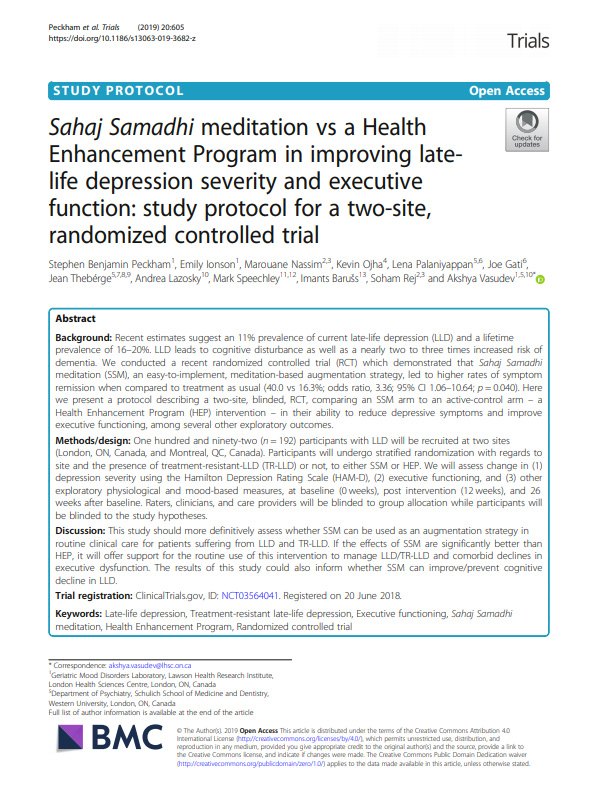
BackgroundRecent estimates suggest an 11% prevalence of current late-life depression (LLD) and a lifetime prevalence of 16–20%. LLD leads to cognitive disturbance as well as a nearly two to three times increased risk of dementia. We conducted a recent randomized controlled trial (RCT) which demonstrated that Sahaj Samadhi meditation (SSM), an easy-to-implement, meditation-based augmentation strategy, led to higher rates of symptom remission when compared to treatment as usual (40.0 vs 16.3%; odds ratio, 3.36; 95% CI 1.06–10.64; p = 0.040). Here we present a protocol describing a two-site, blinded, RCT, comparing an SSM arm to an active-control arm – a Health Enhancement Program (HEP) intervention – in their ability to reduce depressive symptoms and improve executive functioning, among several other exploratory outcomes.Methods/designOne hundred and ninety-two (n = 192) participants with LLD will be recruited at two sites (London, ON, Canada, and Montreal, QC, Canada). Participants will undergo stratified randomization with regards to site and the presence of treatment-resistant-LLD (TR-LLD) or not, to either SSM or HEP. We will assess change in (1) depression severity using the Hamilton Depression Rating Scale (HAM-D), (2) executive functioning, and (3) other exploratory physiological and mood-based measures, at baseline (0 weeks), post intervention (12 weeks), and 26 weeks after baseline. Raters, clinicians, and care providers will be blinded to group allocation while participants will be blinded to the study hypotheses.DiscussionThis study should more definitively assess whether SSM can be used as an augmentation strategy in routine clinical care for patients suffering from LLD and TR-LLD. If the effects of SSM are significantly better than HEP, it will offer support for the routine use of this intervention to manage LLD/TR-LLD and comorbid declines in executive dysfunction. The results of this study could also inform whether SSM can improve/prevent cognitive decline in LLD.Trial registrationClinicalTrials.gov, ID: NCT03564041. Registered on 20 June 2018. Read more
Details
- Author
- S. Peckham, E. Ionson
- Publisher
- —
- Type
- Articles
- Language
- English
- Religion
- —
- Tradition
- —
- Subjects
- Medicine
- Series
- —
- Published
- 2019
- Pages
- 16
- Size
- 8.27 x 10.98 in
- Format
Something wrong on this page?
Related works
-
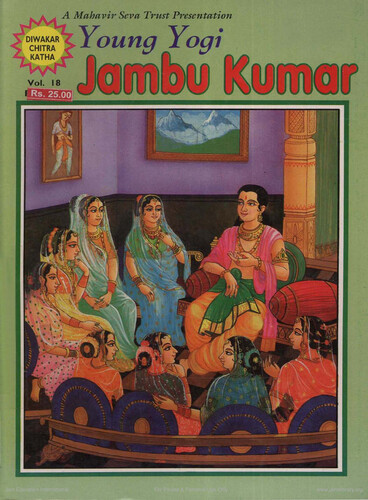 यंग योगी जंबु कुमार
Dr. Rajendra Muni Shastri
यंग योगी जंबु कुमार
Dr. Rajendra Muni Shastri
-
 यशस्तिलक सोमदेव सूरि उच्चवास (भाग 1) (व्हि. 3)
Somdev Suriji Shrimad
यशस्तिलक सोमदेव सूरि उच्चवास (भाग 1) (व्हि. 3)
Somdev Suriji Shrimad
-
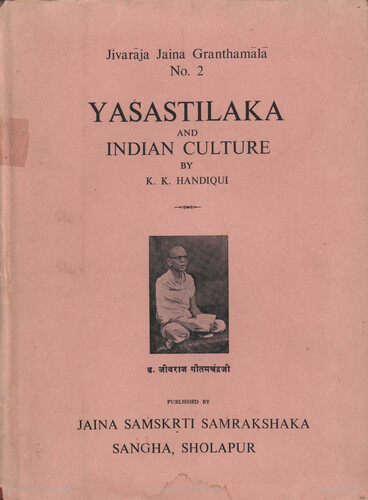 यशस्तिलक ॲन्ड इंडियन कल्चर (अंग्रेजी)
K. K. Handiqui
यशस्तिलक ॲन्ड इंडियन कल्चर (अंग्रेजी)
K. K. Handiqui
- Veetrag Vigyan Pathmala (Part 3) Veetrag Vigyan Pathmala (Part 3) Dr. Hukumchand Bharill
-
 Veetrag Vigyan Pathmala (Part 2)
Dr. Hukumchand Bharill
Veetrag Vigyan Pathmala (Part 2)
Dr. Hukumchand Bharill
-
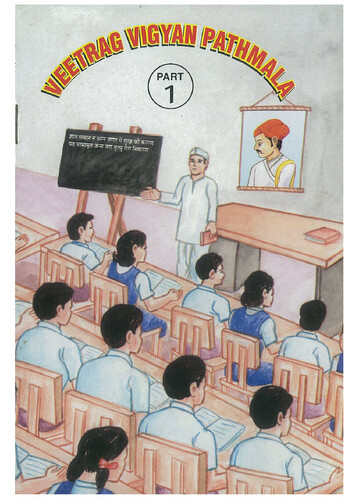 Veetrag Vigyan Pathmala (Part 1)
Dr. Hukumchand Bharill
Veetrag Vigyan Pathmala (Part 1)
Dr. Hukumchand Bharill
-
 युनिवर्सल लॉ (अंग्रेजी)
Unknown
युनिवर्सल लॉ (अंग्रेजी)
Unknown
-
 त्रिशष्टी शलाका पुरुष चरित्र (भाग 6)
Helen M. Johnson
त्रिशष्टी शलाका पुरुष चरित्र (भाग 6)
Helen M. Johnson
-
 त्रिशष्टी शलाका पुरुष चरित्र (भाग 5)
Helen M. Johnson
त्रिशष्टी शलाका पुरुष चरित्र (भाग 5)
Helen M. Johnson
-
 त्रिशष्टी शलाका पुरुष चरित्र (भाग 4)
Helen M. Johnson
त्रिशष्टी शलाका पुरुष चरित्र (भाग 4)
Helen M. Johnson
Reader reviews
No reviews yet
Nobody has reviewed this book. Be the first.
Share your thoughts
If you’ve read this book, sign in to share what you made of it with other readers.