

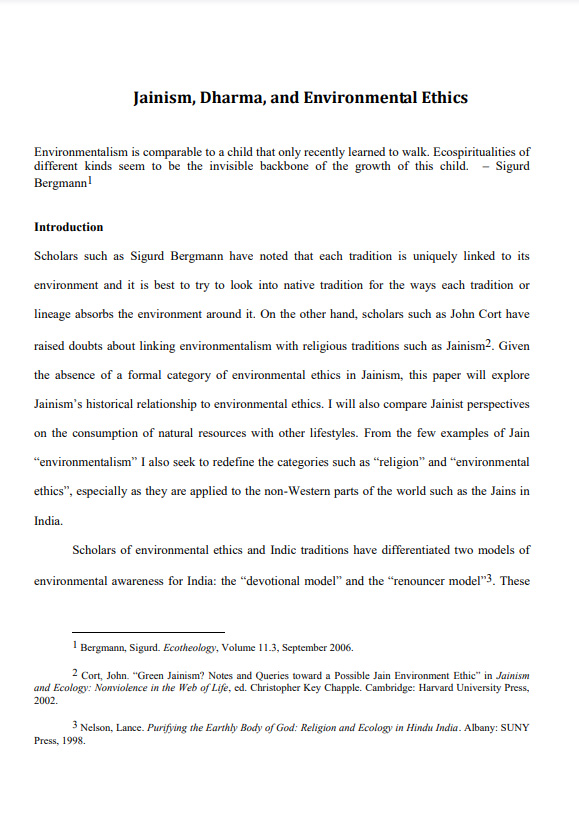
Articles · Spirituality
Jainism, Dharma, and Environmental Ethics
Jainism, Dharma, and Environmental Ethics
Pankaj Jain · Columbia University Libraries
5.0 · 1 review
Sign in to read online
Introduction Scholars such as Sigurd Bergmann have noted that each tradition is uniquely linked to its environment and it is best to try to look into native tradition for the ways each tradition or lineage absorbs the environment around it. On the other hand, scholars such as John Cort have raised doubts about linking environmentalism with religious traditions such as Jainism.2 Given the absence of a formal category of environmental ethics in Jainism, this paper will explore Jainism’s historical relationship to environmental ethics. I will also compare Jainist perspectives on the consumption of natural resources with other lifestyles. From the few examples of Jain “environmentalism” I also seek to redefine the categories such as “religion” and “environmental ethics,” especially as they are applied to the non-Western parts of the world such as the Jains in India. Scholars of environmental ethics and Indic traditions have differentiated two models of environmental awareness for India: the “devotional model” and the “renouncer model.”3 These two models are based on a long-standing dichotomy between the householders and ascetics.4 Householders perform devotional and ritualistic activities whereas ascetics perform austere practices. My fieldwork with the rural communities of Rajasthan and Gujarat suggests that their practices tend to be devotional rather than ascetic. To be sure, the devotional Indians do not reject ascetics. They continue to attend discourses by ascetics and pay their respect to them but their own practices largely consist of daily rituals, puja, at home and at temples.5 Fasting is another common practice performed by Indians. While lay Hindus would eat fruits and vegetables in their fasts, lay Jains avoid water and all Read more
Details
- Author
- Pankaj Jain
- Publisher
- Columbia University Libraries
- Type
- Articles
- Language
- English
- Religion
- —
- Tradition
- —
- Subjects
- Spirituality
- Series
- —
- Published
- 2010
- Pages
- 21
- Size
- 8.5 x 11 in
- Format
Something wrong on this page?
Related works
-
 यंग योगी जंबु कुमार
Dr. Rajendra Muni Shastri
यंग योगी जंबु कुमार
Dr. Rajendra Muni Shastri
-
 यशस्तिलक सोमदेव सूरि उच्चवास (भाग 1) (व्हि. 3)
Somdev Suriji Shrimad
यशस्तिलक सोमदेव सूरि उच्चवास (भाग 1) (व्हि. 3)
Somdev Suriji Shrimad
-
 यशस्तिलक ॲन्ड इंडियन कल्चर (अंग्रेजी)
K. K. Handiqui
यशस्तिलक ॲन्ड इंडियन कल्चर (अंग्रेजी)
K. K. Handiqui
- Veetrag Vigyan Pathmala (Part 3) Veetrag Vigyan Pathmala (Part 3) Dr. Hukumchand Bharill
-
 Veetrag Vigyan Pathmala (Part 2)
Dr. Hukumchand Bharill
Veetrag Vigyan Pathmala (Part 2)
Dr. Hukumchand Bharill
-
 Veetrag Vigyan Pathmala (Part 1)
Dr. Hukumchand Bharill
Veetrag Vigyan Pathmala (Part 1)
Dr. Hukumchand Bharill
-
 युनिवर्सल लॉ (अंग्रेजी)
Unknown
युनिवर्सल लॉ (अंग्रेजी)
Unknown
-
 त्रिशष्टी शलाका पुरुष चरित्र (भाग 6)
Helen M. Johnson
त्रिशष्टी शलाका पुरुष चरित्र (भाग 6)
Helen M. Johnson
-
 त्रिशष्टी शलाका पुरुष चरित्र (भाग 5)
Helen M. Johnson
त्रिशष्टी शलाका पुरुष चरित्र (भाग 5)
Helen M. Johnson
-
 त्रिशष्टी शलाका पुरुष चरित्र (भाग 4)
Helen M. Johnson
त्रिशष्टी शलाका पुरुष चरित्र (भाग 4)
Helen M. Johnson
Reader reviews
5.0
/ 5
Based on 1 review
Review data
- 5 star reviews
- 1
- 4 star reviews
- 0
- 3 star reviews
- 0
- 2 star reviews
- 0
- 1 star reviews
- 0
Share your thoughts
If you’ve read this book, sign in to share what you made of it with other readers.
Recent reviews
-
Mukesh5 out of 5
good